Showing posts with label visual. Show all posts

Sunday, October 2, 2011

5-D Reading Paragraphs

Directions: Read the paragraphs below and answer questions.

Young people do not like mediocre ideals. They prefer to launch out into the deep. It is your right, or, rather, it is your duty to aim high. Your aspirations must be sublime; your ideals high.
Dear young people, strive to build a character that is strong, rich and consistent, one that is free and responsible, sensitive to genuine values, a character that accepts the superiority of “being” over “having,” one that perseveres in challenges and shuns escapism and heartless self-centered calculations.
--Gems of Life
By Manuel de Leon, FMS

a.     What is the main idea of the paragraph?
b.    What kind of character should you build as young people?
c.     Explain: “a character that accepts superiority of ‘being’ over ‘having.’”

5-C Rewriting

Direction: Rewrite the instructions by using should or shouldn't on a sheet of crosswise pad paper.


When ironing your clothes take the following safety precautions:
1.       Read all instructions.
2.       Avoid immersing any part of the iron in water or other liquids to protect yourself against the risk of electric shock.
3.       Always turn the iron to MIN position before plugging to or unplugging from the outlet.
4.       Do not allow the electric cord to touch how surfaces.
5.       Let the iron cool completely before storing it away.
6.     Loop the electric cord loosely around the iron. Store the iron on its heel rest.

5-A Imperatives and Modals

Directions: Give meaning of the signs below. Add subject and should or must in the right place of the sentences you gave.


4-D Word Clusters

Directions: Study the clusters and the italicized words in each of the sentences. Choose words in the clusters that have meanings similar to the italicized words.


1.  Miss Santos drops in a neighborhood store to buy half a dozen candles and lingers for twenty minutes in order to chat.

2. Naturally, the good housewife shows concern.
3. She helps burn the trash.

4-A Reading Map

Directions:
1. Study the map below.
2. Describe the location of the places listed below, using prepositions and prepositional phrases such as: at the corner of, next to, beside, across, on, to the right of, between, behind, to the left of.


a.    Sta. Ana Church
b.    St. Francis School
c.    Barangay Headquarters
d.    Police Station
e.    Metro Bank
f.     Bank of Commerce
g.    Unioil
h.    Senden Homes
i.     City Trust
j.     SSG Supermart
k.    Mercury Drug Store
l.     Vensil’s Photo Shop


3. Give directions on how to go from one place to another.

1.     From the Barangay Headquarters to the Bank of Commerce.
2.     From City Trust to BPI.
3.     From Duyo Optical to San Juan Optical
4.     From Sta. Ana Market to Senden Homes
5.     From Tandoc’s Grocery to Metro Bank


3-D "Why?"

Directions:
1. Read a poem, “Why?”.

WHY?
by A.T. Veloro
There are things I can’t explain,
Things that puzzle the mind,
Questions for which I need
Satisfactory answers to find.
Why the dew on the grass?
Why do flowers die?
Why death of beauteous things?
Why, oh why, oh why?
Why the night, why the day?
Why the lightning’s blinding flash?
Why, the wind’s mighty roar?
Why, the thunder’s deafening crash?
Why do eyes open and close?
Why can’t they keep open?
And shy do they open when I want
Them shut tight in sleep?
Why these things I can’t explain;
But here I am where destiny brings;
My books I read by night and day,
Soon to learn the whys of things.


2. Answer the questions to help general understanding of the text.

a.   Which lines give the general idea of the poem?
b.   Where do you find answers to these questions?


3. Enumerate other questions that you find puzzling.
4. where can you find answers to them?
5. Indicate your sources of information.

3-C What is Dew?

Directions: Read a short passage, “What is Dew?”, then answer questions below.


What Is Dew?
If you are an observant person, you will notice that grass, leaves, and even flower petals contain tiny drops of water in the morning. These tiny drops are actually the result of moisture from the air which has condensed during the night to form dew. Thus, dew is moisture deposited directly from the air on surfaces near the ground, and this change occurs when the temperature cools.
Dew should be differentiated from other types of precipitation, like sleet or drizzle, fog or mist. Sleet or drizzle freezes before reaching the ground: fog or mist, on the other hand, is moisture suspended in the lower atmosphere and does not settle on surfaces.


a.   What is the main idea of the reading passage?
b.   How is dew formed? Differentiate it from sleet and fog.
c.   In which books do you get information on topics like this?

3-B Wh- Question Words Work Sheet 2

2Directions: Look at the pictures below and guess what your teacher wants to talk about. Drag the space below the picture, then you will see sentences for each picture. Those sentences are answers to certain questions. Make the questions by yourself using Wh-questions on a sheet of crosswise pad paper.

a. Meteors are falling stars which travel through space.
b. Earthquakes occur in places where the earth’s crust is not at rest.
c. The Egyptians were among the first civilized people to make shoes.


d. Ice cream originated in the Orient.
e. We have different seasons of the year because of the different ways the rays of the sun strike the sun.

3-A Wh- Question Words Work Sheet 1

Directions: Choose your partner. Study the picture of an interviewee and student and give as many guesses as you can on what they are doing in the picture. Construct questions that the interviewee might ask to the student.


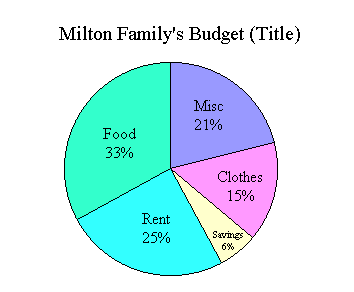
2-B Reading Graphs

Directions:  Study various types of graphs. Answer the questions to know beyond simply knowing the graphs on a sheet of one whole pad paper.

Pictograph

Bar Graph

Line Graph

Pie Graph


1.     What does the graph show?
2.     What do the numbers/pictures/lines/bars represent?
3.     What is the information you can get from the graph?
4.     What are the changes you can see in the graph?
5.     Give an example of the data that can be used in a certain type of graph.

2-A Comparative and Superlative Work Sheet

Direction: Study the products and their maximum storage time in the home freezer. Make comparisons based on the storage capability of these products, using  comparative and superlative degrees of adjectives in your sentences. Use a sheet of crosswise pad paper.

1-A Dramatization

A. Read the script below.

A TOUR TO THE SCHOOL LIBRARY
Librarian: Well, here we are. Do you like it?
Grace: Yes, it’s cool and quiet here.
Anna: Ma’am, could you explain how all these books are arranged?
Librarian: Certainly. I’ll do that as we walk past the book shelves.
Grace: Ma’am, I wonder if you could lend me a dictionary. You see, I’m writing a report in English. I have to be very careful about my choice of words.
Librarian: Sorry, I can’t do that. It’s a reference material that cannot be checked out.
Grace: Why? I’ll return it tomorrow, Ma’am.
Librarian: Reference materials are for room use only. Many students refer to them at all hours of the day, so these materials have to be in the library the whole day. 


B. Answer the following questions.
  1. What are the requests of the two students?
  2. What expressions do they use in making these requests?
  3. What expressions does the librarian use in agreeing to requests or in refusing requests?